出版物

From Scar to Function: Plastic Surgery in the Management of an Extreme Hand Contracture in a Child

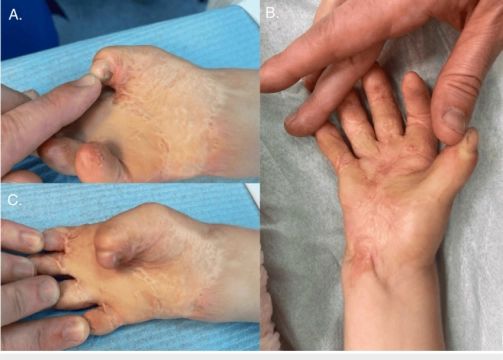
Children are more prone to develop post-burn contractures than adults, even when optimal initial burn care is provided. In severe cases, such contractures may lead to significant deformities and functional impairments. We present a case of a pediatric patient referred to a plastic surgeon at the age of two by his parents, a few months after sustaining third-degree burns to both hands. Although the burns had healed, extensive scarring resulted in severe contractures, leaving the child’s hands tightly clenched and preventing him from extending, flexing, or moving his fingers, thereby severely impairing hand function. A multi-stage surgical plan was established to release the contractures and restore hand function. Over a six-year period, five reconstructive procedures were performed, two on the left hand and three on the right. The surgical strategy incorporated full-thickness skin grafts (FTSGs), multiple Z-plasties, dorsal pentagonal island flaps, Z-plasties, and the use of Kirschner wires to maintain finger extension following passive joint release and contracture correction. This staged approach resulted in the successful restoration of hand functionality and an aesthetically favorable outcome. The postoperative course was uneventful, with minimal pain and no complications. Beyond the physical reconstruction, the regained hand function significantly contributed to the child’s developmental progress, enhancing autonomy, promoting social interaction, and markedly improving overall quality of life.

The Influence of Blood Parameters on the Adhesion of an Epidermal Substitute in the Treatment of Burn Wounds in Children

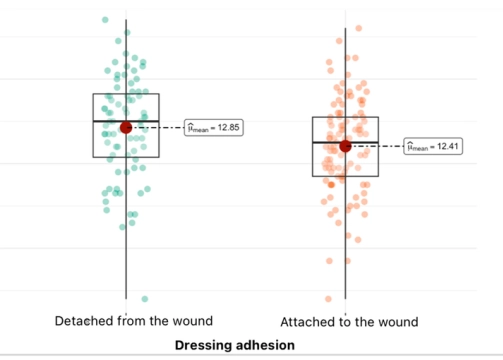
Background: Burns in children represent a significant public health issue, as there is no single targeted dressing for the treatment of burn wounds in children. The alloplastic epidermal skin substitute is the dressing of choice for treating burns in children in our burn center. However, it sometimes occurs that the dressing separates from the wound too early, before the process of full re-epithelialization. The inflammatory phase of wound healing seems to be crucial for maintaining the adhesion of the dressing, and thus, changes in parameters such as leukocyte levels and protein changes are of clinical significance. The aim of our study is to find laboratory factors that could contribute to premature dressing separation. Methods: The documentation of 182 children treated for acute burns at a major Polish burn center in the years 2009–2023 was analyzed. A demographic analysis was performed to collect information. The group was split into the following two categories based on the condition of the dressing: “attached to the wound” and “detached from the wound”. Laboratory tests were collected on admission and with control tests 3–5 days after injury. Results: The results indicate that only a few of the parameters studied showed a statistically significant difference between the groups of patients in whom the dressing did or did not attach. The most pronounced relationship was found for the pre-treatment leukocyte level (leuk1). Statistical significance was also demonstrated for hemoglobin levels and changes in protein (protein_diff) and also glucose levels (glucose_diff). Conclusions: Our study shows that there are blood parameters (leukocyte, protein, and glucose levels) that influence the adhesion of the dressing. Unfortunately, there are no other studies on this topic in the literature, so it seems very important to expand research in this direction.

Influence of Surgical Procedures on C-Reactive Protein Levels in Severely Burned Patients: Preliminary Analysis on Implications for Early Sepsis Diagnosis

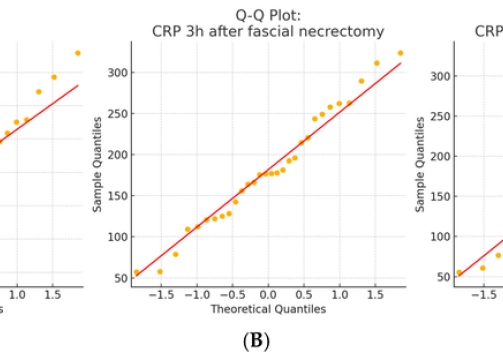
The local treatment of deep burn wounds involves the excision of the necrosis and covering the wounds with skin grafts. Surgical procedures are thought to have an impact on the inflammatory response, especially in severe burn patients requiring treatment in an intensive care unit. Currently, there are no available data in the literature regarding the correlation of the type of surgical procedure and the levels of the inflammatory markers. This study investigates the importance of monitoring c-reactive protein (CRP) around the time of surgical burn procedures and how it can aid in assessing the inflammatory response. Of the 810 burn patients, 93 patients aged 20 to 74 years with IIb- and III-degree burns covering 20% to 50% of the total burned body surface were included in this prospective study. Three subgroups were recognized based on the surgical procedure performed: fascial necrectomy, tangential necrectomy, and skin grafting. The research material included blood samples collected in the early postoperative hours. A total of 270 CRP level measurements were performed. A reduction in CRP levels was observed three hours post-procedure in patients who underwent skin harvesting for grafting. Conversely, a significant increase in CRP levels was noted between postoperative timepoints in patients who underwent tangential necrectomy.